Jungian archetype test: the story behind Archemap
How one founder's fascination with Carl Jung became Archemap, a free Jungian archetype test that maps your archetype and its shadow, and what it grew into.

A Jungian archetype test tries to answer a question most of us ask at some point: why do I keep ending up in the same place? Archemap answers it Jung's way. You have a leading pattern, an archetype, and that pattern has a shadow that takes over when you are under pressure. This is the story of how one founder's fascination with Carl Jung turned into a free test, and how that test is growing into a self-discovery platform.
Why do I keep repeating the same patterns?
You know the feeling. A new job, a new relationship, a new city, and somehow the same argument shows up again. The same kind of burnout. The same moment where you go quiet when you meant to speak.
It is tempting to blame the circumstances. The boss was difficult, the partner was distant, the timing was off. Sometimes that is true. But when the plot repeats across different casts, the common factor is hard to ignore.
Most personality tests stop at describing you. You are an introvert, you are a planner, you are "high in openness". Useful, but flat. They tell you what you are like on a good day.
Carl Jung was more interested in the bad days. His answer to the repeating-pattern question, compressed into one line, goes roughly like this: what you refuse to see in yourself does not disappear, it starts running the show from behind the curtain.
That idea is the seed of Archemap.
Who was Carl Jung, and why do his archetypes still matter?
Carl Gustav Jung (1875 to 1961) was a Swiss psychiatrist who founded analytical psychology. He worked closely with Sigmund Freud early on, then broke with him and built his own map of the mind. The Encyclopaedia Britannica entry on Jung is a solid, sober overview if you want the biography.
Three of his ideas carry Archemap.
Archetypes
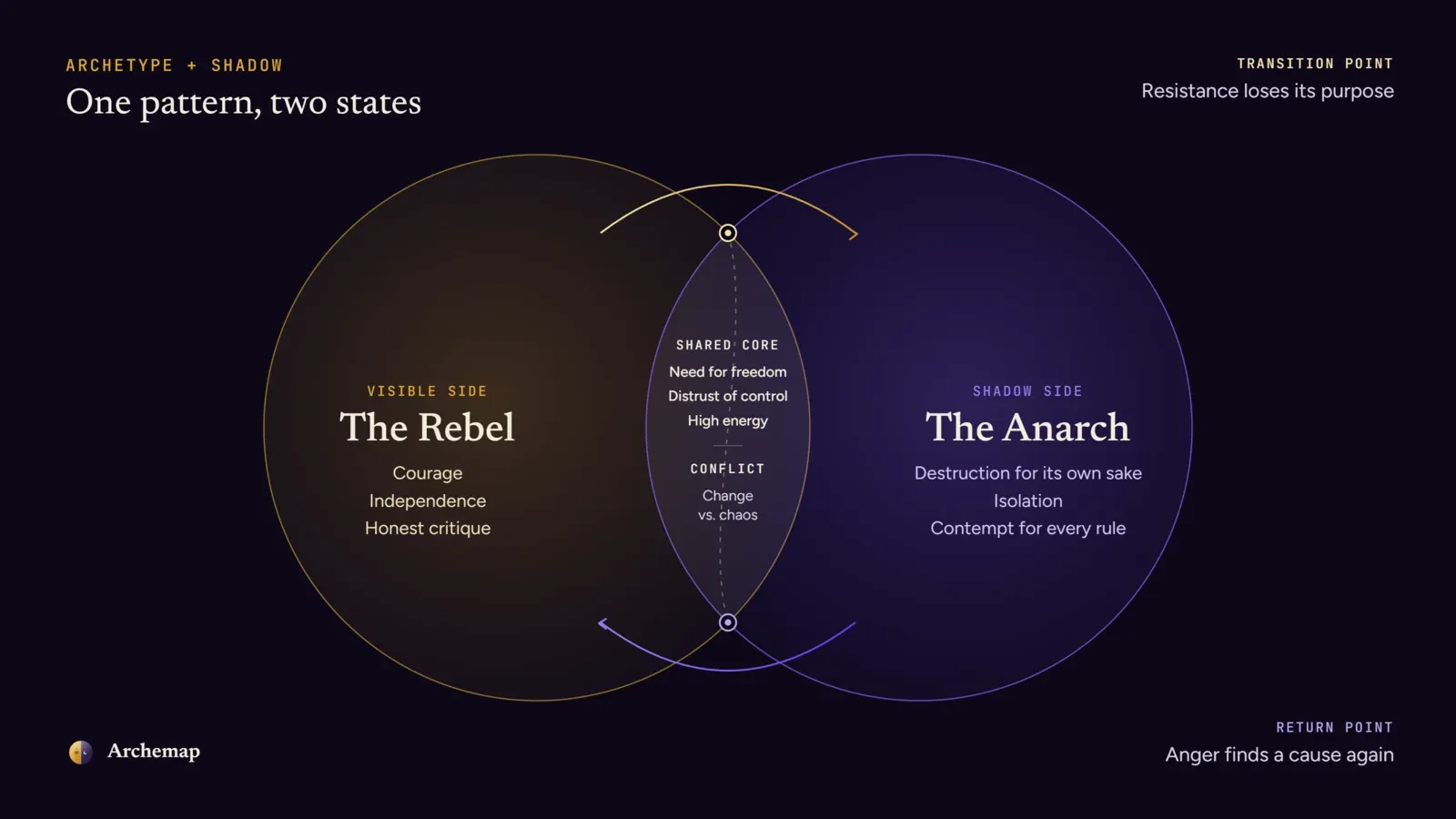
Jung believed that beneath our personal memories sits a deeper layer he called the collective unconscious. It holds archetypes: recurring patterns that show up in myths, dreams and stories across cultures. The hero who leaves home. The wise old guide. The trickster who breaks the rules.
You do not need to accept every part of Jung's theory to find this useful. Archetypes work as a vocabulary. They give names to motivations that are otherwise hard to talk about. Archemap frames an archetype exactly this way, as a recurring symbolic pattern of motivation rather than a permanent box you are stuck in.
The shadow
The shadow is everything about yourself you would rather not look at. Envy and anger live there, sure. So do strengths you were taught to hide, like ambition you were told was rude or a temper that might have been a backbone.
Jung put it bluntly in Psychology and Religion (1938): "Everyone carries a shadow, and the less it is embodied in the individual's conscious life, the blacker and denser it is."
In other words, ignoring your shadow makes it stronger.
Individuation
Individuation is Jung's word for the lifelong process of becoming a whole person: bringing the hidden parts into view and integrating them, instead of fighting them. In Aion (1951) he called the shadow "a moral problem that challenges the whole ego-personality". It is not a quick fix. It is a direction.
If you want to go deeper into Jung's thinking, the C.G. Jung Institute Zürich, founded in 1948 with Jung's direct involvement, still trains analysts today. Archemap also has its own plain-language guide to Carl Jung's archetypes and the shadow.
Why did the founder build Archemap?
Archemap did not start as a market gap on a spreadsheet. It started with a reader.
Its creator came to Jung the way many people do: curious first, then hooked. Archetypes, the shadow and individuation stopped being abstract theory and became a lens. Looking at his own patterns through Jung's ideas helped him understand himself, why certain situations kept repeating and what was going on underneath them.
That personal experience is the whole reason Archemap exists. The thinking was simple: if this framework helped one person see himself more clearly, a well-built test could give other people the same starting point. Not a diagnosis. A mirror with good lighting.
We find this kind of origin more convincing than a pitch deck. Products built from a founder's own use tend to keep the thing that made them useful in the first place, and with Archemap that thing is the shadow.
How did one test grow into a platform?
Here is the path, step by step. We are not putting dates on it, because the order matters more than the calendar.
- One free test. It started as a single test: answer scenario questions, get your archetype and its shadow, free.
- Profiles for every archetype and shadow. Each of the 12 archetypes and 12 shadows got its own page, so a result became a place to read, not just a label.
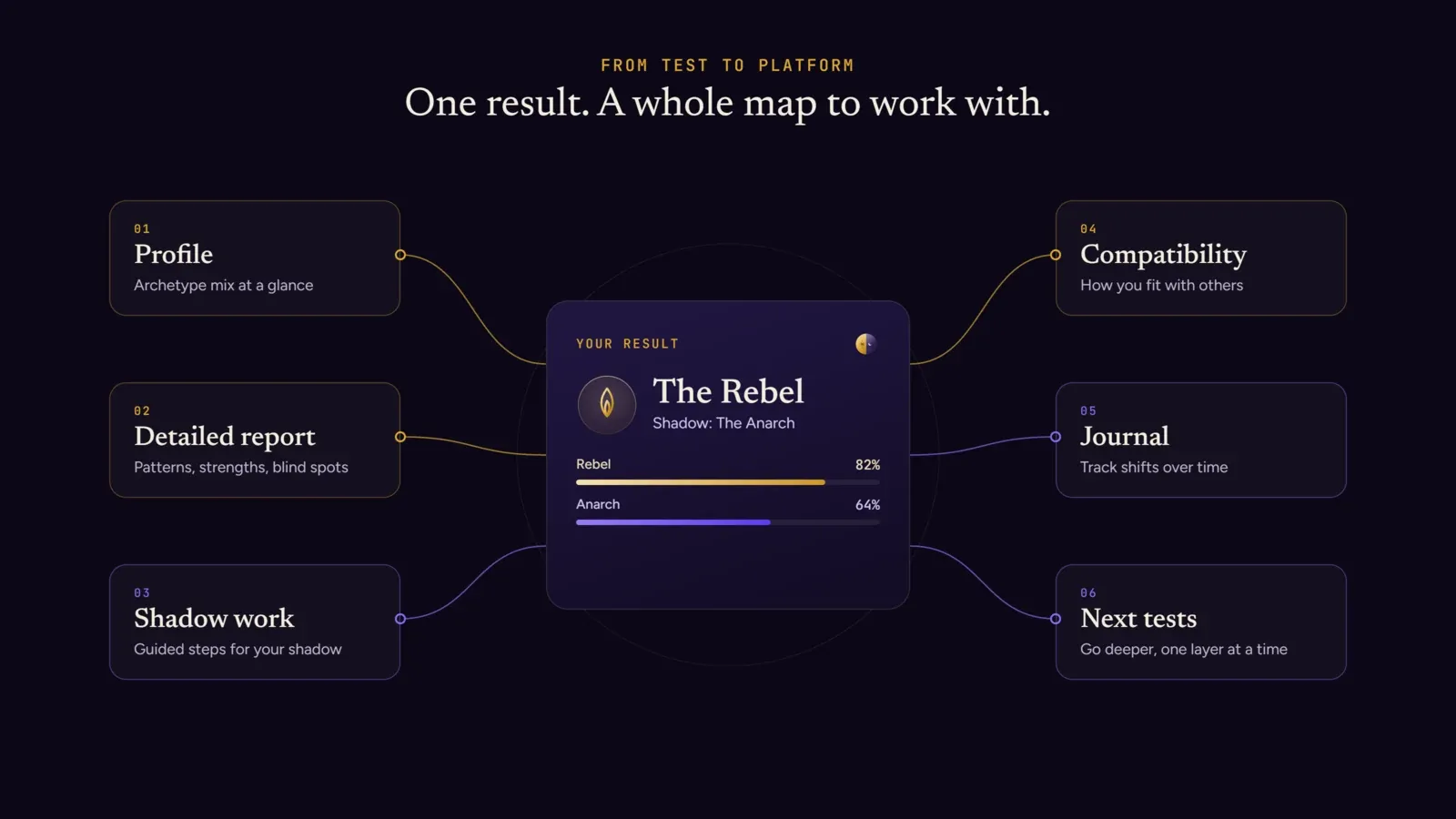
- An in-depth personal report. For people who wanted more than a headline, a long-form report went deeper into the shadow pattern and blind spots. You can preview one in the sample report before deciding anything.
- Relationship compatibility. Patterns get loudest in relationships, so the next step was archetype compatibility for pairs: how two leading patterns, and two shadows, interact.
- A library of free tests. One test became a library of tests: boundaries, love styles, emotional intelligence, the Enneagram, 16 personalities, a shadow work test and more, each looking at your patterns from a different angle.
- A personality map. Every result lands on one personality map: your archetype and shadow at the centre, each new test and journal theme added around them as a layer, so the picture grows instead of resetting.
- A shadow journal and a daily signal. A short daily question and a journal for noticing your shadow in real situations. Both are free, with no signup to start.
- Books and a reading guide. A book library with classic texts on self-knowledge and guided shadow work books, plus a long guide to shadow work for beginners.
- A personal space. Your map, journal, reports, library and progress in one place, which matters because individuation is a process, not a moment.
- Learning material. The Carl Jung guide and a public methodology page explain the ideas and how the test is built.
Notice what is happening in that list. Each step answers the question the previous step raised. "I got the Hero. Now what?" leads to profiles. "Why does my shadow look like that?" leads to the report. "Why do we fight like this?" leads to compatibility. "Where do I see this in my actual week?" leads to the journal and the map.
How does the Archemap test work?
The Archemap test is built around scenarios rather than statements. Instead of asking whether you agree with "I like to be in control", it puts you in a situation and asks what you would actually do.
That is a smart choice. People are bad at rating themselves on abstract traits and much better at recognising their own reactions.
What you answer
As of October 2026 the test has 42 scenario questions. Each answer nudges your score toward some of 12 archetypes. There are no right answers, and the questions are written so that the "nice" option is not always obvious.
What you get
Your result has two halves:
- Your core archetype: the role you tend to live through, with its drive and its gifts.
- Your shadow: what the same pattern turns into when it runs without awareness. Archemap describes it as the distorted or protective version of that pattern that takes over when the role starts to break.
The basic result is free and instant. From there you can read your full archetype and shadow profiles, or go deeper with the personal report.
Is it a scientific instrument?
No, and Archemap says so itself. Its methodology page explains that the questions, weighting and scoring were written by the Archemap team and refined through internal review, and that it is not a licensed or standardised psychometric instrument. It is a self-reflection tool, not a clinical one. We appreciate that honesty more than we would appreciate a borrowed lab coat.
What do you actually do with a shadow result?
This is where a lot of archetype tests leave you hanging. You get a name, a nice description, and then nothing. Here is how we would use an Archemap result in the week after you take it.
- Read the shadow profile before the archetype profile. The archetype page will feel good. The shadow page will feel accurate. Start with accurate.
- Find one recent example. Think of a moment in the last month when the shadow description fit. A meeting where the Ruler in you tipped into the Tyrant. A weekend where the Caregiver quietly became the Martyr and kept score. Write it down in two or three sentences.
- Name the trigger. Shadows rarely show up at random. Look for what came just before: tiredness, criticism, feeling ignored, a deadline. That trigger is the useful data point.
- Ask one person you trust. Show them the shadow description and ask, "Do you ever see this in me?" Their answer is usually more revealing than the test.
- Keep a short log. Patterns shift slowly. A few lines in a shadow journal each week, and a retake after a season, give you something to compare against. That is exactly what Archemap's journal and map are for.
None of this replaces therapy. If a pattern is hurting you or the people around you, a qualified professional is the right next step. A test is a mirror, and a mirror cannot treat anything. What it can do is help you notice.
What are the 12 archetypes and their shadows?
Archemap uses 12 archetypes, each paired with a named shadow. You can browse them all on the archetypes page and the shadows page.
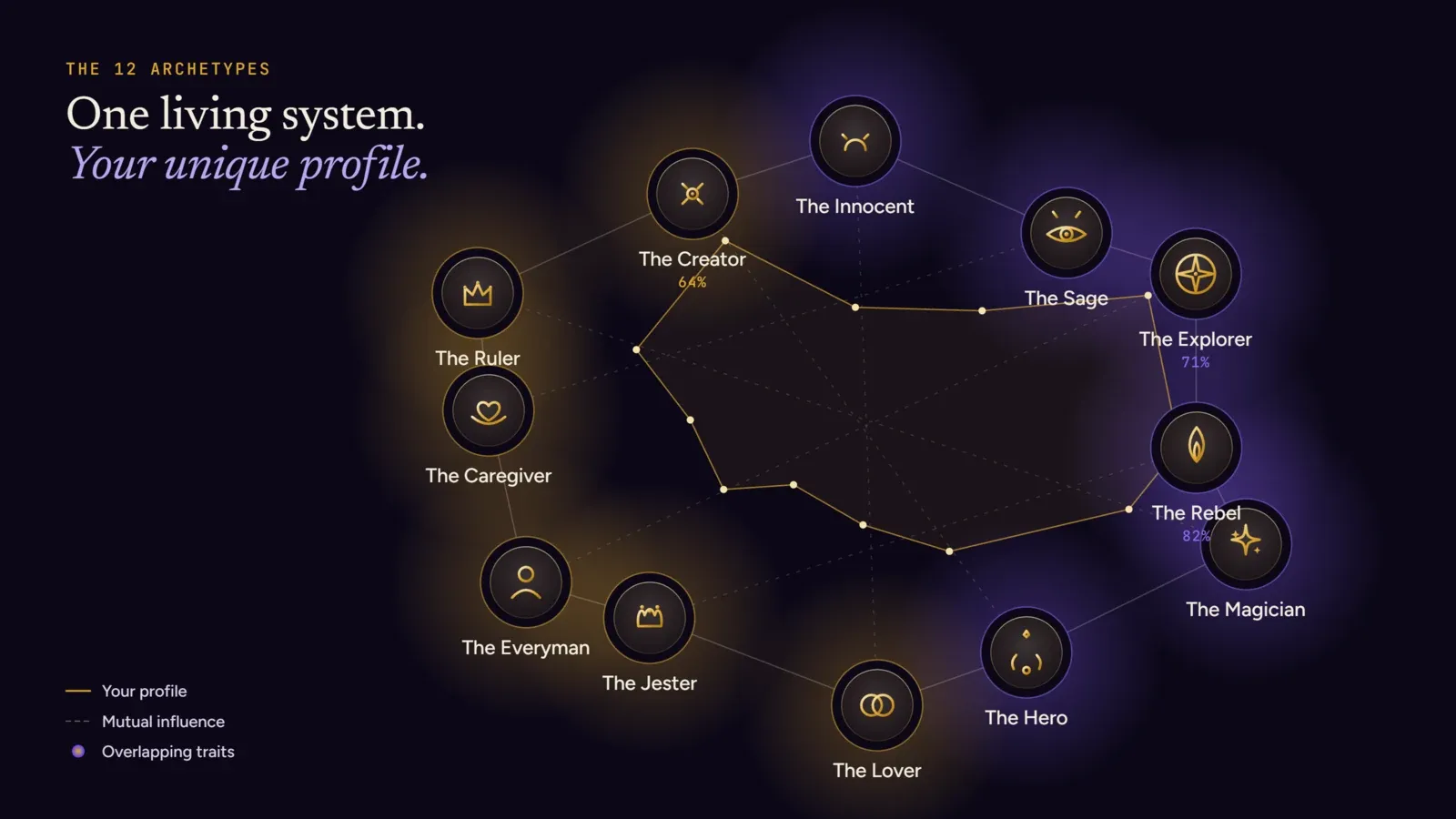
| Archetype | Core drive | Its shadow | When the shadow takes over |
|---|---|---|---|
| Sage | Understanding and truth | The Cynic | Wisdom turns into bitter disillusion |
| Hero | Meeting hard things head on | The Fallen | Courage turns into defeat or martyrdom |
| Rebel | Breaking structures that no longer work | The Anarch | Revolt turns into nihilism |
| Explorer | Room, novelty and self-direction | The Outcast | Freedom turns into rootlessness |
| Creator | Vision and making new things | The Demiurge | Vision turns into control and grandiosity |
| Ruler | Order and responsibility | The Tyrant | Leadership turns into domination |
| Caregiver | Protecting and nurturing | The Martyr | Care turns into guilt and self-sacrifice |
| Innocent | Trust and goodness | The Imposter | Goodness turns into a mask |
| Lover | Closeness and passion | The Obsessed | Passion turns into consuming need |
| Jester | Joy, play and truth through humour | The Disruptor | Play turns into reckless chaos |
| Magician | Transformation | The Manipulator | Change turns into control of others |
| Everyman | Belonging and equality | The Invisible | Belonging turns into self-erasure |
How to read the table
The right-hand columns are the interesting part. The left side describes you when things are fine. The right side shows where the same energy goes when you are scared, tired or overlooked. Three pairs we see in working teams all the time:
- Ruler and Tyrant. The person who holds a project together really does save the team. Under deadline pressure, though, they stop delegating, rewrite other people's work and hear every objection as a mutiny. Same strength, different direction.
- Caregiver and Martyr. The colleague who always picks up the slack and stays late. Until the day they say, "After everything I've done for you." Care that goes unnoticed turns into an invoice.
- Jester and Disruptor. A joke that breaks the tension in a hard meeting. The same joke, at the wrong moment, kills a conversation that needed to be finished.
If you recognised yourself in one of these rows, good. Every archetype has a shadow, and seeing yours is half the work.
A few profiles worth reading even before you take the test: the Hero, the Sage and the Jester. On the dark side, start with the Demiurge, the Creator's shadow. That page is a good example of the tone: it does not call the Creator's shadow evil, it shows how a real gift curdles.
What makes Archemap different from other archetype tests?
There are plenty of "which archetype are you" quizzes. Most are built for a quick share and a nice graphic. Here is what sets Archemap apart, and each point is visible on the site.
Light and shadow in one result
Most archetype personality tests give you the flattering half. Archemap pairs every archetype with its shadow in the same result, so you see your strength and the way it fails at the same time. For anyone interested in shadow work, this is the part that matters.
Practical framing, not mysticism
The profiles talk about motivation, pressure and behaviour, not destiny. The Explorer is described through a need for room and self-direction. The Rebel is someone who refuses structures that no longer work, and whose shadow mistakes disruption for progress. You can recognise those patterns at work on a Tuesday.
A different question from MBTI or the Big Five
It helps to place Archemap next to the tests you already know. The Myers-Briggs Type Indicator also traces back to Jung, specifically to his book Psychological Types (1921), but it sorts you by how you take in information and make decisions. The Big Five, the model most academic personality research relies on, measures five broad traits on a scale.
Both are about how you function. An archetype personality test with a shadow layer asks something else: what drives you, and what that drive becomes when it goes wrong. We would not use Archemap to pick a career or screen a job candidate, and the site does not suggest you should. We would use it to understand a pattern you already half see.
Many languages, written for each
Archemap runs in eight languages: English, Ukrainian, Spanish, German, French, Italian, Japanese and Korean. For a test about inner life, reading it in your first language is not a nice extra. Nuance lives in words.
Where is Archemap heading?
The test was the door. The plan is the house behind it.
The team's stated direction is to grow Archemap from a single test into a full psychological self-discovery platform: deeper tools for understanding yourself and your relationships, and for following how your patterns shift over time. The personality map, the shadow journal and the compatibility tool are the first pieces of that, and parts of the map are still being built. A membership for people who want to go deeper is in the works. The next step they are working toward is making the platform something you return to, not something you finish.
That fits Jung better than any one-off quiz could. Individuation was never meant to be a result screen. It is closer to a long conversation with yourself, and a platform that remembers where you were last month can support that conversation in a way a single test cannot.
Will it get there? That depends on execution, as it does for every young product. But the order of steps so far, each one answering a real follow-up question from users, is the kind of momentum we like to see.
If you track tools in this space, you can find more on our psychology, wellbeing and self-growth hub, or browse new products in Woodander Discover.
Should you try it?
If you have ever caught yourself mid-pattern and thought "here I go again", yes. Give it a quiet stretch of time, answer the scenarios honestly rather than aspirationally, and read the shadow half of your result twice. That is where the useful part usually hides.
You can take the Jungian archetype test for free, and read more about the project if you want the background first.
FAQ
Is the Archemap test free?
Yes. The main test and its result, your core archetype and your shadow, are free. So are the other tests in the library, the journal and the daily signal. The in-depth personal report and the books are separate, optional purchases.
Is the Archemap test scientifically validated?
No. Archemap's methodology page says the test is inspired by Jung's archetype theory, that its questions and scoring were developed and reviewed internally, and that it is not a licensed or standardised psychometric instrument. Treat it as a structured self-reflection tool, not a diagnosis.
What is a shadow archetype?
In Jung's psychology the shadow is the part of the personality you do not acknowledge. In Archemap each archetype has a matching shadow: the distorted or defensive version of the same drive that appears under pressure, such as the Ruler becoming the Tyrant.
How long does the test take?
The current test has 42 short scenario questions and shows your result instantly when you finish. We would set aside a calm ten to fifteen minutes so you answer from instinct rather than in a hurry.
What archetype am I?
Only your answers can tell. The archetype you admire most is often not the one you live through, which is exactly why a scenario-based test is more revealing than picking from a list.
Can I take it in my own language?
Yes, if it is one of eight: English, Ukrainian, Spanish, German, French, Italian, Japanese or Korean. Each edition has the test, the profiles and the guides.